Gulf of Mexico
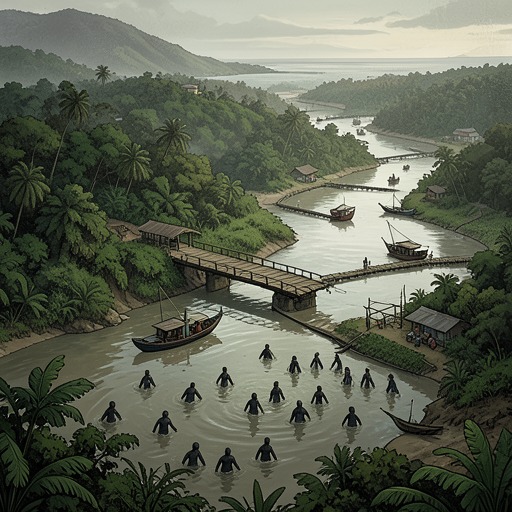
Secret InvasionThe Gulf of Mexico marks the crisis’s decisive geographical turn: Sliggers are no longer understood as an East Coast infestation, but as a threat moving through Gulf waters toward the Mississippi River and inland. Reports from Perdido Key, Alabama, Louisiana, and Port Arthur force investigators to revise their account of the spread and redirect a large-scale response toward connected waterways.
From coastal outbreak to Gulf crisis
At first, the pattern of attacks makes the danger seem like a coastal problem. Mason tells the others that reports from widely separated places—including an attack at a Georgia campground and video of eggs on a Florida beach near St. Augustine—point to multiple nests along the coast. Denise draws the grim implication: separate locations mean creatures and eggs may be hidden in many places, and people could be killed before anyone knows where the next attack will occur. The Gulf later changes the scale of that warning. It is not simply another point on the same coastline; its appearance signals that the outbreak has crossed the limits of the response’s initial East Coast focus.
The first explicit warning of that shift comes when the group learns that an attack occurred at Perdido Key, on Florida’s western tip. When Ron asks whether this means the creatures have reached the Gulf of Mexico, the answer is yes. His immediate concern is about the direction of movement: he argues that Gulf currents push east toward Florida’s southern tip, rather than carrying things around the peninsula and into the gulf. The question of how the creatures reached the Gulf is therefore not a minor geographical puzzle. It makes the established account of their spread inadequate.
A revised route of spread
Subsequent reports deepen the problem. Andy searches his phone and finds more attacks west of the group’s current position. The investigators later conclude that coastal currents have carried the creatures along the Gulf, moving east from somewhere farther west. Port Arthur, a small Texas city on the Texas-Louisiana border, is identified as the westernmost location where attacks have been reported so far. That finding gives the Gulf outbreak a direction and a known outer limit, but not a confirmed point of origin: the reports establish where the creatures have been seen, while their earlier path remains uncertain.
The shift also changes what counts as the most urgent destination. Gina suggests sending Ron’s team to Port Arthur, where the westernmost reports have appeared. Ron instead wants to go to Louisiana and examine the Mississippi River, whose potential for carrying the infestation inland concerns him more. Their disagreement is practical rather than a denial of the Texas reports: the response must cover both the furthest confirmed western site and the waterway Ron sees as the greater route of expansion. Their proposed plan divides the force into thirds—one contingent to Port Arthur, another to continue westward from its position in Florida, and the last to reach the Mississippi and follow the creatures’ trail upriver.
From scattered reports to coordinated response
The crisis’s widening geography brings a wider government response. Before the Gulf reports, governors in Virginia, New York, South Carolina, Georgia, and Florida have called in the National Guard, and the president has ordered the United States Coast Guard to become involved. Later, a declaration of a National State of Emergency accompanies reports of attacks in the Gulf, including places in Alabama and Louisiana and, especially, the Mississippi River. What had appeared to be progress in wiping out the East Coast creatures no longer guarantees containment. The river’s reach inland makes the threat difficult to confine to the shoreline.
The military deployment turns the proposed three-part strategy into an operational search. At a briefing, Billingsly tells his National Guard troops to avoid the Sliggers’ toxic appendages and to kill them without explosives, following Denise’s warning. He lays out a route that will take his unit from New Orleans up the Mississippi River, while two other infantry divisions approach from Florida and Texas. Ron recognizes this as the arrangement he recommended: a coordinated sweep from multiple directions, with the river treated as a corridor that must be searched rather than a boundary that can be watched from the coast.
Containment along the Mississippi
The later account makes the connection between the Gulf’s expansion and the upriver operation concrete. Four days after the creatures break into a hotel room in Baton Rouge, Army Reserve troops find and destroy a nest near the Mississippi, at the river’s edge. Ron’s team continues north with the searchers. They reach St. Francisville without finding another nest, and the group comes to believe that the spread has been stopped. The investigation has covered forty more miles of waterways since the Baton Rouge nest was located, without a further monster being discovered.
Ron’s assessment to the Department of the Interior also records why the search could not be treated as ordinary pest control. The creatures reproduce asexually and evolve rapidly in response to different environments; their extermination therefore had to be both comprehensive and clean. He reports that the creatures found were eliminated without leaving remains that could contaminate the ecosystem and mutate its animals. In this account, the Gulf of Mexico is more than the setting for a new cluster of attacks: it is the hinge between a coastal emergency and a potentially inland invasion, and the water route along which containment is tested.